Join confidence
Guest name, invited email, verification code, lobby, admission, and reconnection are tested as one flow.
QEYET Meet
Schedule from QEYET Calendar, invite any email address, verify guests, control the lobby, and keep decisions and actions in an encrypted Meeting Capsule tied to the event.
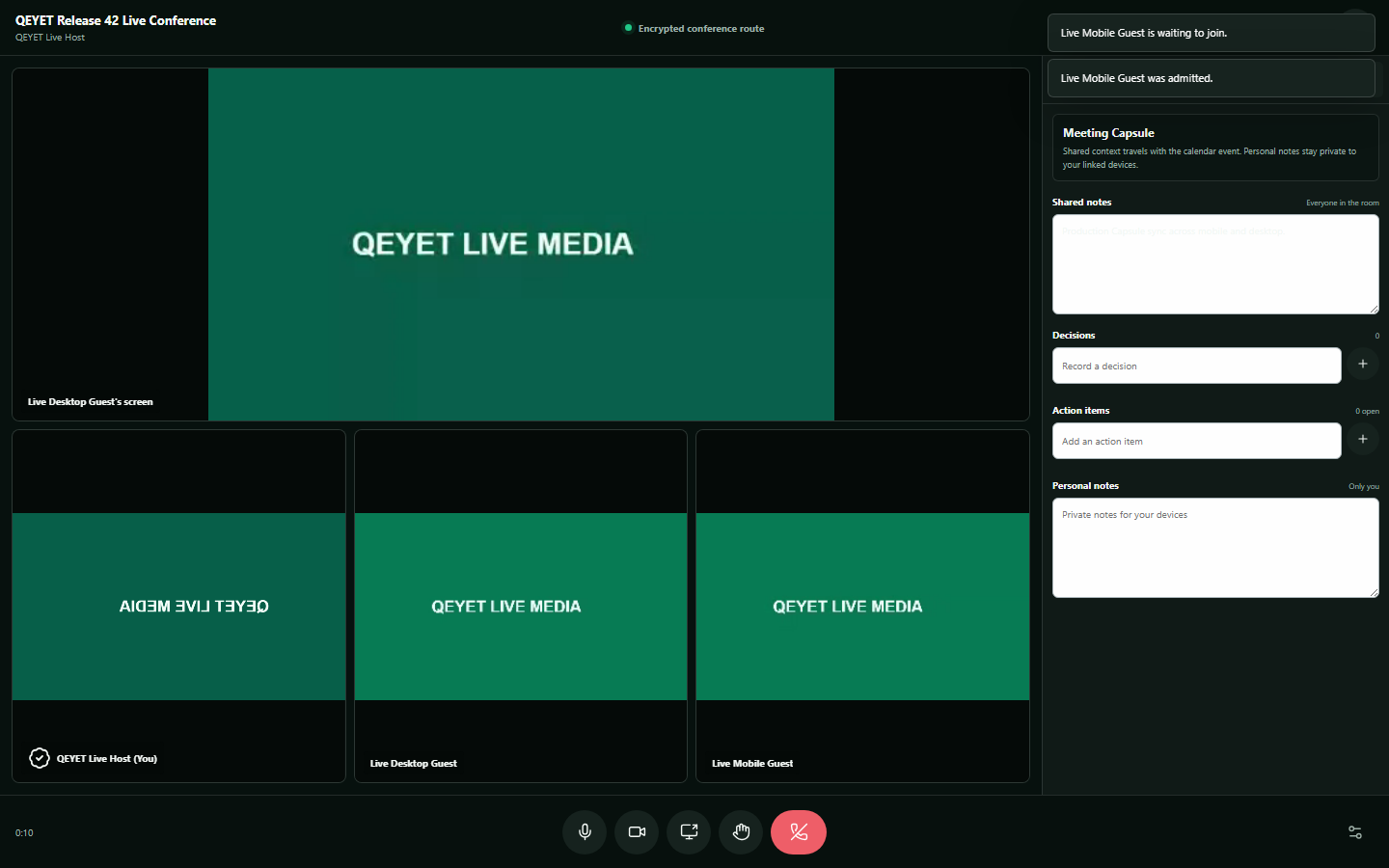
From the calendar invitation to the follow-up, the useful context stays connected.
Small calls can use direct WebRTC. Group conferences can use QEYET's self-hosted SFU so each participant does not need to upload a separate copy of every track. TURN remains a compatibility fallback for restrictive networks.
An admitted participant can still photograph, record, quote, or disclose what they can see and hear. Encryption does not make a trusted attendee unable to copy meeting content.
Meeting flows are exercised in Chromium, Safari's WebKit engine, Firefox, Edge, desktop layouts, and mobile layouts before release.
Guest name, invited email, verification code, lobby, admission, and reconnection are tested as one flow.
Form values, chat, and Capsule inputs use explicit browser paint colors with contrast assertions across engines.
Tests cover live media, unavailable-media states, background blur capability, and screen sharing controls.
Atomic releases retain rollback paths for the meeting client, routing node, SFU, and static suite.